I just read a really nice paper about the usage of words counts to derive psychological measures.
Their method called language style matching (LSM) was able to generate nice correlations with diverse phenomena.
For example, the show a relation between LSM and relationship stability (via dating protocols), income distribution (via craigslist) and wiki site rankings (via discussion threads).
Further, they refer to some nice example of how to use huge collection of data to derive new knowledge.
WeFeelFine.org gives you a real time impression of the current feeling of twitter users and books.google.com/ngrams serves as historical view on our linguistic features.
Showing posts with label Blog Analysis. Show all posts
Showing posts with label Blog Analysis. Show all posts
Friday, August 23, 2013

Monday, January 7, 2013
"News Information Flow Tracking, Yay!" - Suen et al.
Nifty is an evolution of the Memetracker project.
This time they implemented an incremental approach to their meme clustering.
What I specially like about their paper is the massive test data set of over 20 terabyte.
This data set consists of 6.1 billion blog post that they collected over 4 years.
One dry run of their clustering takes hereby less than 5 days.
For detail information please refer to the paper.
This time they implemented an incremental approach to their meme clustering.
What I specially like about their paper is the massive test data set of over 20 terabyte.
This data set consists of 6.1 billion blog post that they collected over 4 years.
One dry run of their clustering takes hereby less than 5 days.
For detail information please refer to the paper.
"Influence and Correlation in Social Networks" - Anagnostopoulos et al.
The authors describe a statistical test for actions in social networks.
This test helps to distinguish correlation from causality for information propagation in social networks.
Hereby, the author's test first calculates the probability for one user influencing the other user.
Afterwards, they shuffle action times of the user and test again.
To get a detailed insight into the statistical concept please take a look at the paper.
This test helps to distinguish correlation from causality for information propagation in social networks.
Hereby, the author's test first calculates the probability for one user influencing the other user.
Afterwards, they shuffle action times of the user and test again.
To get a detailed insight into the statistical concept please take a look at the paper.
Thursday, August 16, 2012
Why PageRank & Co. are inferior for blog ranking?
PageRank is one of the most frequent used algorithms for ranking traditional webpages based on the web link graph. It has been introduced by Page et al. and is based on the random surfer model. A website’s PageRank is defined as the probability of a random surfer visiting this website.
The random surfer traverses the web by repeatedly choosing between two options: clicking on a random link on the current page or jumping to any website at random. The second option is necessary to make sure the random surfer also visits pages that have no incoming links and to make sure that it is possible to escape from pages that have no outgoing links.
The PageRank algorithm is iterative and converges after a certain number of iterations depending on the used implementation.
A very similar algorithm to PageRank is TrustRank.
In contrast to PageRank, TrustRank gets initialized with a fixed set of trusty or untrusty web sites. The trust propagates through the web graph equally to the PageRank algorithm.
Another approach is the Hyperlink-Induced Topic Search (HITS) algorithm by Kleinberg.
It is based on the concept of Hubs and Authorities. In the traditional view of the web Hubs are link directories and archives that only refer to information Authorities, which actual offer valuable information.
HITS operates on a subgraph of the web that is related to a specific input query. Each page gets an Authority score and a Hub score. The Authority score get increase based on the Hub score of linking webpages and vice versa.
These traditional ranking algorithms are all based on the web link graph.
However, traditional webpages show a different linking behaviour as blogs. Blogs offer different types of links, e.g. trackbacks or blogroll links, with different semantics. Furthermore, the blog link graph tends to be rather sparse in comparison to the overall web.
Thus, tailor-made rankings for blogs are needed that also consider blog-specific characteristics and blogs' content.
Wednesday, August 1, 2012
Summary of "Credibility Improves Topical Blog Post Retrieval - Weerkamp et al."

The timeliness of a post is defined as the temporal distance of a blog post to a news post of the same topic. In this paper, topics seem to be term occurrences. Nonetheless, it is very interesting to incorporate traditional media.
The posting/publishing behaviour of a blogger is called regularity. Hereby, the authors assume that a credible blog has a very regular posting behaviour. In contrast, related research often assumes this as an indicator for splogs.
The topical consistency of a blog represents its topical fluctuation. The authors define the consistency similar to the query clarity, which remembers me a bit of the tf/idf score. As contrast to related work, the authors do not use the natural ordering of posts.
Nevertheless, the author show that their indicator can improve the topical blog retrieval significantly (using the blog06 data set).
Take a look at the paper.
Tuesday, July 31, 2012
Summary of "Domain-Specific Identification of Topics and Trends in the Blogosphere - Schirru et al."
The authors present a system called "Social Media Miner". This
system extracts topics and the corresponding, most relevant posts.
The relevance is calculated using a link authority algorithm like
PageRank. The main contribution of the paper is the topic detection and
tracking mechanism.
Schirru et al. cluster blog post using a time windowing approach. To
create the cluster they use a tf/idf vector for each blog post, k-means, and non-negative matrix factorization for label extraction. To define the number of clusters they use the
residual sum of squares.
Nevertheless, their approach is rather simple. They cluster topics for a
given period, find relevant terms (or labels), and visualize the term mentions
over time as Trend Graph.
Check out the paper.
Summary of "Cool Blog Identification using Topic-based Models - Sriphaew et al."
The authors show how to identify cool blogs based on three assumptions:
blogs tend to have definite topics, have enough posts, and tend to have a
certain level of consistency among their posts.
The level of consistency or the topical consistency tries to measure
whether a blogger focus on a solid interest thus it favours blogs with certain
topics like reviews on mobile devices. It is based on a mixture of topic
probabilities of posts (LDA). The authors measure the similarity preceding
posts. Hereby, the similarity is the distance between the topic probability
distributions, which is calculated using Euclidean, Kullback-Leibler, or
Jensen-Shanon distance.
They conduct a "user study" based on a corporate blog data set
and a single guy, who categorized 540 blogs in cool and not cool. Using a SVM
implementation, the authors were able to show an accurate precision and recall
for cool blog recognition.
This is a heuristic approach and can therefore be applied to any
language following the same assumptions.
So, check out the paper.
So, check out the paper.
Summary of "Splog Filtering based on Writing Consistency - Liuwei et al."
 |
| CR: kinipela |
They define the consistency of the writing interval as the inverse variance of post update intervals. A high writing interval consistency implies a very constant update interval.
The authors also define a measure for consistency of writing structure. Unexpectedly, there is no NLP magic behind this; the measure simply relates the variation of words per post and the average number of words per post. The underlying assumption is that splogs are packed with keywords and their posts are all equally long. As contrast, normal blogger tend to deliver short and long posts depending on their daily mood.
The consistency on topic level is defined as the average topical similarity of posts. Each post gets compared with its preceding post. The topical similarity is defined as the cosine similarity of the posts' tf/idf word vectors. Thereby, blogs with a very high topical consistency tend to be auto-generated.
Finally, they introduced a filtering system and evaluated their feature set with three classification mechanisms (SVM, Bayes, C4.5) on the Blog06 data set. They showed that with a reduced feature number the same accuracy is reachable using their feature set. Further, one has to mention that their heuristic approach is language independent.
Wednesday, July 25, 2012
Summary of "Using Blog Content Depth and Breadth to Access and Classify Blogs" - Chen et al.
Here, I sum up another interesting paper concerning a content-based ranking of blogs.
Blog assessment. PageRank, HITS, and Technorati's blog
authority have two issues: sparseness of links and time lagging of score.
Further, most blog search engines are based on simple retrieval models because
they only access the limited content of feeds and have to struggle with real-time
constraints.
The authors present a blog-specific filtering system that
measures topic concentration and variation.
They asses the quality of blogs via two main aspects:
content depth and breadth. This got motivated via the sparseness of links and
the highly personal character of the blogosphere.
The related work essentially consists of two areas: blog and
quality assessment.
 |
| D3 forces layout of German blogs |
Quality assessment. According to Joseph Juran, quality is
the "fitness for use" of information. Common quality assessment
metrics are based on heuristics for a specific situation. Thereby, researchers emphasise
the differences in language, structure and importance of actuality of blogs.
Further, blogs are more interesting, personal, and reflect the author's
opinions/experiences. Thus, researches define the quality of a blog based on
the blogger's expertise, trustworthiness, information quality, and its personal
nature. In addition, the credibility of commentators also counts.
In essence, the authors present a score that relates 5
criterions.
The first criterion is the informativeness of a blog as the
number of meaning full words. A meaningful word has a high tf/idf score.
Secondly, the completeness of a blog indicates how much strongly related words
from each mentioned topic are present.
Third criterion is the topic count per blog. Fourthly, the
inter-topic distance specifies how much words of a post are shared between
topics.
Finally, the topic mergence calculates the general overlap
between topics.
The authors conduct a small user study to prove their
scoring.
Chen, M. and Ohta, T. (2010), Using Blog Content Depth And Breadth To Access and Classify Blogs. International Journal of Business and Information Volume 5, number 1, June 2010.
Chen, M. and Ohta, T. (2010), Using Blog Content Depth And Breadth To Access and Classify Blogs. International Journal of Business and Information Volume 5, number 1, June 2010.
Summary of "An effective coherence measure to determine topical consistency in user-generated content - Jiyin He et.al"
Here, I sum up an interesting paper concerning a content-based ranking of blogs.
A blog is relevant if it focuses on a central topic. This is called topical consistency.
The authors introduce the coherence score to measure the consistency.
It is based on the intra blog clustering structure relative to the clustering of the background collection.
One has to differentiate between short and long term interest in blogs.
Further, the key features of blogs are a strong social aspect and their inherent noisiness.
The topical noise springs from random interest blogs or diaries. This creates topical diffuseness ( a loose clustering).
One has to find the blogger that is most closely associated with a specific topic.
Blogs mostly fail to maintain a central topical thrust. Nevertheless, the trend goes to rank full blogs to recommend the reader interesting feeds.
One has to take the time and the relevance of topics into account.
Thereby, recurring interest (time based) and focused interest (cohesiveness of language of posts) should get measured.
The authors' coherence score captures the topical focus and tightness of subtopics in each blog. Thus, it handles the focused interest.
Lexical cohesion is an alternative to the coherence score. It measures the semantic relation hips between content words.
Therfore, external thesauri like WordNet are used to build lexical chains. The number of chains reflect the number of distinct topics. A so called chain score is used to measure the significance of a lexical chain.
The lexical cohesion is sensitive to progression of topics, but blind to their hierarchical structure.
The coherence score gives the proportion of coherent document pairs relative to the background collection.
These pairs are calculated by thresholding the cosine similiarty of documents.
The score measures the relative tightness of the clustering for a blog and prefers structured document sets with fewer sub-clusters.
Thus, the coherence score captures the clustering structure of data, called topical consistency.
It is independent of external resources and adapts to the fast changing environment of blogs.
Its complexity is O(average document length * number of documents ^2) and it can be used beyond text data (eg. blog structure or linkage).
It gets integrated into a blog ranking for boosting the topical relevant and topical consistent blogs.
A blog is relevant if it focuses on a central topic. This is called topical consistency.
The authors introduce the coherence score to measure the consistency.
It is based on the intra blog clustering structure relative to the clustering of the background collection.
One has to differentiate between short and long term interest in blogs.
Further, the key features of blogs are a strong social aspect and their inherent noisiness.
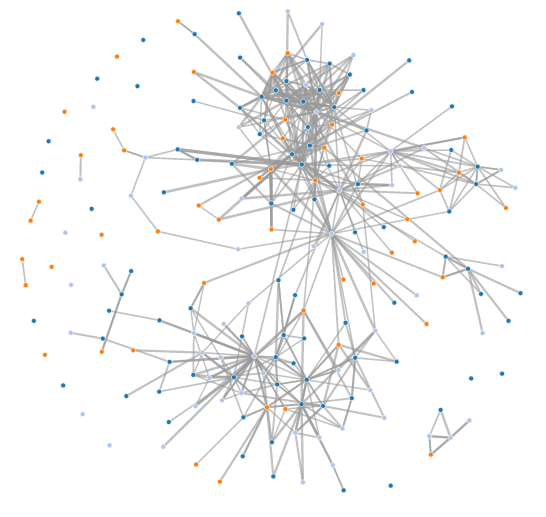 |
| Forces Layout of blogs interlinkage using D3 |
One has to find the blogger that is most closely associated with a specific topic.
Blogs mostly fail to maintain a central topical thrust. Nevertheless, the trend goes to rank full blogs to recommend the reader interesting feeds.
One has to take the time and the relevance of topics into account.
Thereby, recurring interest (time based) and focused interest (cohesiveness of language of posts) should get measured.
The authors' coherence score captures the topical focus and tightness of subtopics in each blog. Thus, it handles the focused interest.
Lexical cohesion is an alternative to the coherence score. It measures the semantic relation hips between content words.
Therfore, external thesauri like WordNet are used to build lexical chains. The number of chains reflect the number of distinct topics. A so called chain score is used to measure the significance of a lexical chain.
The lexical cohesion is sensitive to progression of topics, but blind to their hierarchical structure.
The coherence score gives the proportion of coherent document pairs relative to the background collection.
These pairs are calculated by thresholding the cosine similiarty of documents.
The score measures the relative tightness of the clustering for a blog and prefers structured document sets with fewer sub-clusters.
Thus, the coherence score captures the clustering structure of data, called topical consistency.
It is independent of external resources and adapts to the fast changing environment of blogs.
Its complexity is O(average document length * number of documents ^2) and it can be used beyond text data (eg. blog structure or linkage).
It gets integrated into a blog ranking for boosting the topical relevant and topical consistent blogs.
Jiyin He, Wouter Weerkamp, Martha Larson, Maarten de Rijke: An effective coherence measure to determine topical consistency in user-generated content. IJDAR 12(3): 185-203 (2009)
Subscribe to:
Posts (Atom)